
Curricular
AHEC Tobacco Training and Cessation – Initial Training (ATTAC-IT)
The ATTAC-IT Program is an interdisciplinary tobacco training program for health professions students. It is sponsored and coordinated by the University of Florida Area Health Education Centers (AHEC) Program in collaboration with a dedicated team of faculty members from the Colleges of Dentistry, Medicine, Nursing, Pharmacy, and Public Health and Health Professions. The program provides a foundation for future healthcare providers, preparing them for their roles in tobacco use prevention and cessation interventions, which are critical for improving the health of their patients, their communities, and the state of Florida.
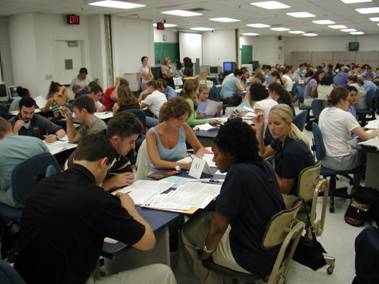
ATTAC-IT is a two-part program, made up of an Afternoon of Learning (AOL) and a Day of Service (DOS). For the AOL, health professions students in UF’s disciplines of Dentistry, Health Education, Medicine (including future MDs and PAs), Nursing, Pharmacy, and Public Health and Health Professions begin by individually completing online preparatory materials. The students then come together for a two-hour large-group presentation by experts on current evidence-based strategies for treating tobacco use and dependence, motivational interviewing techniques, and alternative forms of tobacco. The students spend an additional two hours divided into small interdisciplinary groups as they engage in cooperative learning activities that expand further on tobacco prevention, cessation interventions, and motivational interviewing.
As part of the small-group learning experience, the students are provided with a middle-school tobacco education curriculum that they later implement in area schools to complete the second part of ATTAC-IT, the Day of Service. For the DOS, the students spend a day engaging middle school youth in tobacco prevention education through videos and interactive activities, thus serving as role models for the youth and reinforcing what they learned about tobacco during the Afternoon of Learning.
In 2011, 820 health professions students participated in ATTAC-IT, visiting middle schools in 17 counties. Since 2007, more than 4,000 health professions students have participated in ATTAC-IT, reaching over 80,000 middle school youth with tobacco prevention education. Funding for the UF AHEC Tobacco Training and Cessation Program Afternoon of Learning is provided through the Florida Department of Health as part of Florida’s Comprehensive Tobacco Control Program. Funding for the Day of Service is provided as part of a collaborative HRSA grant through the UF College of Dentistry.
Caring for Patients with Disabilities (required for all students in the participating colleges)
Second-year medical students and third-year physical therapy students attend a panel including providers and a patient who has had a stroke. The discussion centers on experiences in working with other providers, and the perspective of a patient.
- This is followed by a lecture/demonstration on safe patient transfers and also how to assess functional status.
- A one-hour small group session uses photo-maps and patient perspectives as a basis for discussion.
- Lastly, groups of 2 med students and 1 PT student examine 2 real patients (from Center for Independent Living and the PT patient pool.) Medical students will practice asking about functional status with guidance as needed from PT student. Then one student will assist with transfer in order to do a supine heart exam. Both students will do the heart exam on each patient. Students will seek help from PT student as needed.
EMR Software: Interprofessional training (required for all students in the participating colleges)
This grant-supported project is establishing a dummy educational version of electronic medical record (EMR) systems in use in the Colleges of Dentistry, Medicine and Pharmacy. This educational version will be used to teach health professions students as well as post-graduate residents how to utilize the EMR system. Studies suggest that earlier exposure to EMR systems results in a higher utilization of high level EMR services (such as screening reminders, appointment keepers and discussion aids for patients). Additionally, interprofessional cases will be developed which will allow students from different health care disciplines to work together as a team. The four phases of this project are as follows:
- Student will be taught how to enter patient data into an EMR in a correct and efficient format.
- Students will be taught how to effectively communicate with a patient as data are entered into the EMR.
- Each college will develop cases that require longitudinal care, including developing a patient care plan and a SOAP note.
- Interprofessional cases and communication methods will be developed.
Extracurricular
The Mobile Outreach Clinic is a highly flexible means of delivering health care to the medically under-served in low income neighborhoods and rural areas in and around Alachua County. The Mobile Clinic itself is a large bus containing two exam rooms, a laboratory and a waiting area. It is currently staffed by a registered nurse who can screen, refer, and provide case management. The Mobile Outreach Clinic is in operation an average of five days per week (please consult our calendar on the homepage for exact times and dates.). Students from the colleges of medicine, pharmacy, nursing and law participate on the bus.
Equal Access Clinic is a student run free healthcare clinic which provides free episodic care and other services to the medically underserved in the Gainesville community. Health professional students from the University of Florida Colleges of Medicine, Dentistry and Public Health volunteer together under the supervision of Shands/UF faculty to assess and treat patients. The clinic is on Thursday nights and is located at the UF Family Practice Medical Group. This clinic begins at 6:00pm and treats the first 15 patients. It is first come, first serve. Available services include primary care, social work and psychological consultations, administration of medications, blood pressure and blood sugar monitoring , confidential HIV counseling and testing, referrals to WECARE and emergency dental referrals to the UF dental clinic.
GCM Clinic is a student run free healthcare clinic which provides free care and other services to the medically underserved in the Gainesville community. This clinic was designed to be a medical home for those with chronic medical issues. Health professional students from the University of Florida Colleges of Medicine, Pharmacy and Public Health volunteer together under the supervision of Shands/UF faculty to assess and treat patients. The clinic is held on Tuesday nights at Gainesville Community Ministries. It is first come, first served and begins at 5:00pm. This clinic sees approximately 10-12 patients per night.
HealthStreet is a community-based effort that works everyday to reduce disparities in healthcare and research by linking the medically underserved to medical and social services and opportunities to participate in research. Community Health Workers (CHWs) meet residents at health fairs, special events, bus stops, parks, laundromats, grocery stores, libraries, and other locations in North Central Florida. Community members can also visit HealthStreet to access free services, including health screenings, use of computers, educational classes, and many more. Our aim is to improve relationships between community members, health care providers, community organizations, and researchers in the University of Florida community. Student volunteers from all the Health Science Center colleges to provide assistance with community education and outreach, grant writing, data entry and analysis, and preparation of materials and publications.
Helping Hands Clinic- is a medical home for the homeless population in Gainesville. It is located at the First Methodist Church in downtown Gainesville. The clinic offers medical care and prescription assistance. They also offer psychiatric care. The clinic is held on Mondays and there is a special clinic for women’s health on Thursday nights. University of Florida residents and faculty, and community physicians see patients on the 2nd and 4th Mondays and 1st and 3rd Thursdays of the month. The clinic offers medication management, crisis counseling, and supportive therapy. They emphasize continuity of care. Students from Colleges of Medicine, Pharmacy, Nursing, Public Health and Health Professions, Law, and Physician Assistant and Social Work programs volunteer with this organization.
International trips- Students go to Dominican Republic, Ecuador. Haiti, Mexico, Nicaragua and Thailand each spring break. Students from Colleges of Medicine, Pharmacy, Nursing and Dentistry plan and execute the trips, with faculty input and oversight. The trips provide students with a brief immersion experience in cross-cultural medicine. They learn firsthand about the health inequities that exist in low resource settings and, with our partners from those settings, help meet the needs for health and dental services for community members in primarily rural settings. The College of Pharmacy has a trip to Yucatan that also includes Audiology students and a trip to El Salvador that includes MPH students.
Flu Mist program
Alachua County residents may be among the most protected in the United States against contracting influenza, and it’s all possible because of a three-year volunteer-driven campaign coordinated by interprofessional leaders from UF’s Emerging Pathogens Institute to immunize children in local schools. UF nursing students, many of whom participate in the program, help inform parents of school-aged children about the importance of flu prevention. The FluMist program is part of a UF nursing curriculum that focuses on population care, and students from medicine, public health and pharmacy also participate.
UF Heroes/SWAG Partnership
UF HEROES (Health and Education for Research, Outreach, Empowerment, and Services) is a student organization that aims to educate and increase awareness about local health and educational concerns and provide support in the community. It has formally partnered with the Southwest Advocacy Group (SWAG) to provide essential services, programming and evaluation centered around the Family Resource Center which will open in Spring 2012. Students from the College of Medicine and College of Public Health work directly in the community.